So I'm reading the book Made to Stick: Why Some Ideas Survive and Others Die by Chip and Dan Heath and its leaving my mind a whirl of ideas and possibilities. The main premise of the book is that to make ideas stick you must craft a message that the listener can easily recall through the use of metaphors that they can relate to and can be easily recalled. But I digress.
While reading the chapter on developing messages that are concrete in which the authors argue that you can reach more people with concrete ideas rather than abstract notions, I have another aha! moment. I seem to be having a lot of these lately. As you may or may not be aware I have been laboring to figure where I, as an instructional designer, fit into a world where informal learning seems to be the future.
Then it came to me. Maybe it was a result of watching the latest episode of Dr. Who the night before, an episode called The Shakespeare Codes, that instructional designers need to learn to be Bards, to tell concrete stories that convey the Subject Matter Experts' abstractions. Some stories can be minute mysteries while others can be longer opuses. The key is that the learner can access them at any time without jumping through a lot of LMS hoops.
Sunday, July 15, 2007

Friday, July 13, 2007
An "Aha" Moment
I was viewing Stephen Downes vodcast titled: Web 2.0 and Your Own Learning and Development. I'm doing research on personal learning environments for a presentation of my own when Mr. Downes said something that really made me stop and think, in fact I rewound the video to listen again to what he had to say. (approximately 16:40 into the video)
I have been trying to clarify in my own mind how formal training/education fits into the new world of informal learning that people such as Stephen Downes or Jay Cross have been advocating. I mean, what Mssrs. Downes and Cross have been advocating made sense to me, but I always felt that informal learning could not work without formal education. How could a person conceive what type of immediate learning is needed if they were not aware of the general scope of the issue.
Say, for example a researcher is hired by a pharmaceutical firm. Being new to the company, she has no idea how they monitor their drug trials; she may know in general how drug trials are run, but each of individual pharmaceutical company will have its own policies and procedures. Without a formal learning session where she is introduced to these policies and procedures she is left to learn on her own, which, in the pharmaceutical world can be extremely dangerous.
So she attends the formal training and receives the data dump over a course of say 3 days. In my early days of learning about instructional design I recall being told something along the line that 75% of what a learner is provided in the training session is forgotten within an hour of leaving the class if it is not immediately applied and 90% is lost within three days of the training. As I recall these figures were presented as an argument for incorporating practice sessions within the class so that the learner can apply their new knowledge.
Having been on the receiving end of training where practice was provided I can argue that the loss of the skills presented in the training occurred anyway if I did not apply them outside the classroom. (Either that or I'm just a poor student.) This is where informal learning comes into play and the responsibility of the employer to provide the informal resources for the employee to refresh in their mind what they learned.
This could be via:
The last place you want to get your information is in a formal classroom. Why? Because you are taking a class you don't need it now, you need it when you are out doing work or something like that. So what you want to do for the most part is shun formal classes and sessions in favor of informal activities. That's not to say you should never take a formal class, a formal class is great for an information dump, but if you want information finely tuned to your needs you're going to have to look to informal methods.
I have been trying to clarify in my own mind how formal training/education fits into the new world of informal learning that people such as Stephen Downes or Jay Cross have been advocating. I mean, what Mssrs. Downes and Cross have been advocating made sense to me, but I always felt that informal learning could not work without formal education. How could a person conceive what type of immediate learning is needed if they were not aware of the general scope of the issue.
Say, for example a researcher is hired by a pharmaceutical firm. Being new to the company, she has no idea how they monitor their drug trials; she may know in general how drug trials are run, but each of individual pharmaceutical company will have its own policies and procedures. Without a formal learning session where she is introduced to these policies and procedures she is left to learn on her own, which, in the pharmaceutical world can be extremely dangerous.
So she attends the formal training and receives the data dump over a course of say 3 days. In my early days of learning about instructional design I recall being told something along the line that 75% of what a learner is provided in the training session is forgotten within an hour of leaving the class if it is not immediately applied and 90% is lost within three days of the training. As I recall these figures were presented as an argument for incorporating practice sessions within the class so that the learner can apply their new knowledge.
Having been on the receiving end of training where practice was provided I can argue that the loss of the skills presented in the training occurred anyway if I did not apply them outside the classroom. (Either that or I'm just a poor student.) This is where informal learning comes into play and the responsibility of the employer to provide the informal resources for the employee to refresh in their mind what they learned.
This could be via:
- Procedural guides published as wikis in which the end users at the very least can comment on the information so that they can recommend changes that improve the process being performed
- Blogs that can provide them with alerts to changes in policy, government regulations, etc.
- Chat rooms or groups where they can share information and ideas
- Podcasts and vodcasts that discuss critical elements in their activities that they can use to recall what was presented in the information dump that was the formal training
- Web-based simulations that allow them to fine-tune their activities.
Wednesday, July 11, 2007
Podcasting and Education
This news article from Campus Technology suggests podcasting does not add to "learning." Consensus: Podcasting Has No 'Inherent' Pedagogic Value
We need to take these findings to heart, because the people involved are what we call digital natives and are supposed to take to learning 2.0 technologies like fish to water.
A bevy of recent studies on students' experience listening to recorded lectures via podcasts confirms what many lecturers already know: that the pedagogical value of podcasts depends almost entirely on student motivation and the learning "context" of the application.The article links to a longer Carnegie Mellon University report, A Teaching with Technology White Paper: Podcasting, that suggests that replacing in-person lectures with video or audio lectures is not advisable, but does think there is a place for podcast lectures as refreshers or as supplemental materials or even as homework assignments. The Carnegie Mellon white paper reviewed three experiments in lecture podcasting at:
- the University of Michigan School of Dentistry
- Harvard Extension School
- the University of Washington
- Audio podcasts were preferred over video podcasts or podcasts with audio and still images
- Majority of students listened/viewed lecture podcasts at a computer despite the flexibility of loading it to an mp3 player or iPod
- Most used the podcasts as a refresher from actual classroom lectures and downloading increased when the podcasts were syndicated via an RSS feed
- The real potential of podcasts is to design as supplementary material designed specifically for the format. One approach is "sonic sessions" that interpret one or two important topics and offer questions for considerion.
- Another use of podcasts is having students create podcasts for the instructor to review. One example, students working pairs created 6 to 10 minute video podcasts "sharing something that they learned during the previous class.
We need to take these findings to heart, because the people involved are what we call digital natives and are supposed to take to learning 2.0 technologies like fish to water.
Powered by ScribeFire.
Monday, July 09, 2007
Don't blog, write...
So says Jakob Nielson in his latest Alertbox
Write Articles, Not Blog Postings (Jakob Nielsen's Alertbox)
Mr. Nielsen then goes on to explain in what he himself calls "...a very long article, stuffed with charts and statistical concepts..." why it is not in the best interest for the world leader to emulate most blogs being published. A great number of these consist of short posts (maximum 7 to 10 paragraphs) linking to a news article, report, or some other official publication and providing the writer's opinion of that linked item.
Mr. Nielsen recommends that longer, well-researched articles posted on a regular basis should be the model the world leader follow, if that world leader wishes to make money from his or her efforts. Of course this sounds like the old model "White Paper" that can already be found on a great number of corporate websites, which, ironically are given away for free.
While I agree there is a log of chafe that a reader has to wade through (including this site) to find the nuggets in the blog world, I can't help but feel that Mr. Nielsen has a real problem with what he dismisses at the end of his article as the "so-called Web 2.0 movement."
Having been a loyal reader of Mr. Nielsen for probably about 6 years I couldn't help detect a bit of peevish elitism coming through in this article and he misses the value of the blog as a means of leveling the publishing playing field and where ideas can come from the most unexpected places, not just handed down on high from "world leaders."
For instance, after throwing a fig leaf to blogs by arguing that they have a role in business as project blogs, he argues that "[b]logs are also fine for websites that sell cheap products...For many B2B sites with long sales cycles, quick hits...are insufficient. Instead, these sites need to build up long-term customer relationships based on respect." What sales has to do with his world leader is beyond my grasp.
But then it appears that the way people use blogs appears to be beyond Mr. Nielsen's understanding. He writes as if people use search engines to find blog posts.
Ironically, I fear that any world leader that follows Mr. Nielsen's concluding advice will suffer the same fate (figuratively speaking) as Marie Antoinette whom it paraphrases.
Write Articles, Not Blog Postings (Jakob Nielsen's Alertbox)
You probably already know my own Internet strategy, so it might not surprise you that I recommended that he should instead invest his time in writing thorough articles that he published on a regular schedule. Given limited time, this means not spending the effort to post numerous short comments on ongoing blogosphere discussions. (bold facing is from original)To a large degree I have to agree with him given the context in which he positions his argument, i.e., he was advising "a world leader in his field" on whether the leader should start a weblog.
Mr. Nielsen then goes on to explain in what he himself calls "...a very long article, stuffed with charts and statistical concepts..." why it is not in the best interest for the world leader to emulate most blogs being published. A great number of these consist of short posts (maximum 7 to 10 paragraphs) linking to a news article, report, or some other official publication and providing the writer's opinion of that linked item.
Mr. Nielsen recommends that longer, well-researched articles posted on a regular basis should be the model the world leader follow, if that world leader wishes to make money from his or her efforts. Of course this sounds like the old model "White Paper" that can already be found on a great number of corporate websites, which, ironically are given away for free.
While I agree there is a log of chafe that a reader has to wade through (including this site) to find the nuggets in the blog world, I can't help but feel that Mr. Nielsen has a real problem with what he dismisses at the end of his article as the "so-called Web 2.0 movement."
Having been a loyal reader of Mr. Nielsen for probably about 6 years I couldn't help detect a bit of peevish elitism coming through in this article and he misses the value of the blog as a means of leveling the publishing playing field and where ideas can come from the most unexpected places, not just handed down on high from "world leaders."
For instance, after throwing a fig leaf to blogs by arguing that they have a role in business as project blogs, he argues that "[b]logs are also fine for websites that sell cheap products...For many B2B sites with long sales cycles, quick hits...are insufficient. Instead, these sites need to build up long-term customer relationships based on respect." What sales has to do with his world leader is beyond my grasp.
But then it appears that the way people use blogs appears to be beyond Mr. Nielsen's understanding. He writes as if people use search engines to find blog posts.
The beauty of the blogosphere is that it's a self-organizing system. Whenever something good appears, other blogs link to it and it gets promoted in the system and gains higher visibility. Thus, the 24 postings that are better than our expert's very best attempt will gain higher prominence, even though they're written by people with lower overall expertise.But the beauty of blogs is that the people the world leader wants to influence are not those who are going to stop after the first 24 returns, but who will continue to dig. And once they find that world leader's blog they will subscribe to it and receive all future postings automatically.
Ironically, I fear that any world leader that follows Mr. Nielsen's concluding advice will suffer the same fate (figuratively speaking) as Marie Antoinette whom it paraphrases.
Elite, expertise-driven sites are the exception to the rule. For these sites, you don't care about 90% of users, because they want a lower level of quality than you provide and they'll never pay for your services. People looking for the quick hit and free advice are not your customers. Let them eat cake; let them read Wikipedia.But that's just my opinion, for what its worth.
Powered by ScribeFire.
Tuesday, July 03, 2007
Will Blog for Money
Could there be a lucrative future in ghost-blogging? For the right price I would be willing to serve as the online presence for a wealthy executive or high-profile Hollywood type.
BBC NEWS | Technology | Are my online friends for real?
BBC NEWS | Technology | Are my online friends for real?
As Facebook continues its explosive growth here's one question troubling me. Are my friends for real?
Powered by ScribeFire.
Wednesday, June 20, 2007
Flash drives for learners

Fleeting thought for the morning. What if ITL classrooms have dedicated laptops for each learner seat. Then each learner will be given a USB flash drive that has been programmed to autolaunch some sort of knowledge storage, such as a standalone wiki like Tiddlywiki, that contains the participant's guide and links to other job aids.
USB flash drives are dirt cheap nowadays and would make a great takeaway from the training.
Monday, June 18, 2007
How much is too much?
So I have a client who expressed concern about reusing certain images in an elearning course my employer is creating for them. The problem is that the size of the course is so large and its subject matter is so intense (WMD response) that the number of images are limited.
So as I review images being used I am wrestling with the question of how much is too much. I recall that Ken Burn's lengthy documentary on the Civil War seemed to reuse certain images that had emotional impact repeatedly. Of course he also zoomed in close to the image and then panned across it to create a sense of moving pictures.
I would like to think that certain reuse of dynamic pictures is acceptable if it helps to either:
So as I review images being used I am wrestling with the question of how much is too much. I recall that Ken Burn's lengthy documentary on the Civil War seemed to reuse certain images that had emotional impact repeatedly. Of course he also zoomed in close to the image and then panned across it to create a sense of moving pictures.
I would like to think that certain reuse of dynamic pictures is acceptable if it helps to either:
- Reinforce the surrounding content
- Serve to make the information more memorable.
Monday, June 11, 2007
Wednesday, June 06, 2007
Valuable Tips for Running Small Wikis
The folks at Teaching Hacks.com
posted a lengthy article offering valuable recommendations about
running a small wiki. They observe that a small wiki with 50
contributors cannot be run the same way as Wikipedia, which has 43,000 contributors. Read the whole article: Tips on Developing a Wiki Community.
posted a lengthy article offering valuable recommendations about
running a small wiki. They observe that a small wiki with 50
contributors cannot be run the same way as Wikipedia, which has 43,000 contributors. Read the whole article: Tips on Developing a Wiki Community.
Powered by ScribeFire.
Tuesday, June 05, 2007
Back to the basics
 Sometimes its the little, common-sense things we often forget about when we are subject matter experts. That's why I found this little wiki page fascinating.
The 30-minute masters - Learning 1.5 Wiki
I think all instructional designers should have to read this at least once every six months.
Powered by ScribeFire.
"Coursels:" I love the term.
One of the great things about where I work is that people are always sharing great sites. This morning we were pointed to the Articulate blog and to a particular blog entry titled: 5 Myths About Rapid E-Learning. What particularly caught my eye was a bullet point under Myth 2: Rapid e-learning is important, but it's a second class product!
Develop a coursel mindset. Coursels are “course morsels.” They are bite-sized chunks of information and learning. Instead of building large training programs, make your strategy to build a series of coursels that address very specific topics. With the coursels you can develop just-in-time material to address immediate needs. In addition, you can tie your coursels together to create whole courses. You can also use the coursels to blend with and augment other training in the organization.This has been a thought that has been rumbling around in that huge vacuum I call a brain. Coursels could be another term for microlearning, which is already growing in the European community. These could be real simple how-to's for a lot of the small tasks that all workers are confronted with such as:
- how to complete an expense report
- how to submit a narration report for audio production
- how to record your voice mail greeting
Powered by ScribeFire.
Thursday, May 31, 2007
The Balancing Act
Could this be a morality play for future difficulties in the corporate world as the push continues to institute blogs and wikis?
Qu's Marsh
Corporations will be under pressure to maintain a level of decorum in the information marketplace and it is inevitable that incidents like this can happen. It is already happening as corporations
Qu's Marsh
For those who haven't heard, LiveJournal.com, and its corporate parent, Six Apart, have permanently suspended hundreds of accounts without warning or explanation. Investigation from sleuthy LiveJournal users has determined that this was apparently done to delete accounts allegedly promoting incest, but many of the suspended accounts include users discussing Vladminir Nabokov's novel Lolita and support communities for survivors of abuse, LiveJournal obviousy did a pretty crappy job. It's obvious that they didn't make even the slightest attempt to investigate the accounts before deleting them, nor did they contact the users to let them know what the problem was or how they could remedy it. The accounts were simply wiped without warning, contrary to LiveJournal's own Terms of Service (see Section XIV, 2).
Corporations will be under pressure to maintain a level of decorum in the information marketplace and it is inevitable that incidents like this can happen. It is already happening as corporations
- try to block employees from accessing improper web sites and end up blocking appropriate sites as well.
- Use spam filters to block spammers and catch legitimate client emails as well.
Powered by ScribeFire.
Spam-o-vision
Is this an indication that electronic communications has jumped the shark? Or is it just the fact that we still crave face-to-face communication over the rather sterile computerized communication? E-Mail Reply to All: 'Leave Me Alone' - washingtonpost.com:
The supposed convenience of electronic mail, like so many other innovations of technology, has become too much for some people. Swamped by an unmanageable number of messages -- the volume of e-mail traffic has nearly doubled in the past two years, according to research firm DYS Analytics -- and plagued by annoying spam and viruses, some users are saying "Enough!"What happens when we can instantly communicate with everyone via camera and microphone? And spam follows suit...
Those declaring bankruptcy are swearing off e-mail entirely or, more commonly, deleting all old messages and starting fresh.
Wednesday, May 23, 2007
It's a Twitter world
This is totally off subject, but I can't help but post about this: Twittervision. Twittervision displays every twitter post on a map of the world so you can see where the poster is located. It's kind of like being a voyeur except people are volunteering this information.

Wikis as a Pedagogical tool
I was catching up on my blog reading when I came across a short entry at elearningpost about the use of wikis in education. It is a rather indepth paper published by Renée Fountain of the Université Laval School of Education that explores the potential and hurdles of implementing wikis as a pedagogical tool in the classroom.
While Renée's work focuses on the wiki's use in the university setting as a read through it many of the points seemed applicable in the workplace training site as well. What really hit me was this point made early in the piece:
While Renée's work focuses on the wiki's use in the university setting as a read through it many of the points seemed applicable in the workplace training site as well. What really hit me was this point made early in the piece:
In this model students will not simply pass through a course like water through a sieve but instead leave their own imprint in the development of the course, their school or university, and ideally the discipline."
Thursday, May 17, 2007
The Learning Circuits Blog: Dear Hollywood (a heads up from the training world),
So with tongue planted firmly in cheek, Clark Aldrich fires a volley across the bow of the rapid-development, just-in-time learning crowd. The Learning Circuits Blog: Dear Hollywood (a heads up from the training world). My favorite part:
I can tell as a fact that no one has 3 hours anymore. No one. It is IMPOSSIBLE to find 3 hours in people's schedules. People are just too busy.
Learn from me. If I propose any program, I make sure it takes less than 30 minutes, and maybe even less than 15 minutes of a person's time. My motto is deliver a bit of information exactly when they need it and move on. My ultimate goal is to be a faint, useful smell wafting through the corridors. That is, after all, the easiest conversation to have with my business colleagues.
Read it all.
Monday, May 14, 2007
Why minimal guidance doesn't work for novices
Last week my coworkers had an extensive back-and-forth email exchange regarding the article on current research on PowerPoint published by the Sydney Morning Herald. It began when a coworker emailed the hyperlink to the news article (http://www.smh.com.au/news/technology/powerpoint-presentations-a-disaster/2007/04/03/1175366240499.html) and highlighted two key findings:
- It is more difficult to process information if it is coming at you in the written and spoken form at the same time. (So don't read the bullets on a slide).
- Teachers should focus more on giving students the answers, instead of asking them to solve problems on their own
We all agreed that PowerPoint can be deadly as I noted in a previous posting. There was some confusion over that second finding, and since the news article was vague I volunteered to contact Dr. Sweller regarding that item. I specifically asked him:
Specifically I am interested in a paraphrased statement in the article that was published in the Sydney Morning Herald that states the following:"The findings that challenge common teaching methods suggest that instead of asking students to solve problems on their own, teachers helped students more if they presented already solved problems."Am I correct in interpreting this to mean you think learners should be shown a solved problem with the instructor showing them how it is to be solved? Would you then follow up with additional problem which would allow the learner to practice what they were shown?
Dr. Sweller's replied:
In answer to your specific question, when we use worked examples, we normally follow them immediately with an appropriate practice problem.
To summarize, I was correct in my assumption that Dr. Sweller was not advocating just giving learners the answers, but rather he argues that teachers should demonstrate how a solution to a problem is resolved so that learners can determine the logic behind it AND THEN follow up with an appropriate practice problem.
What Dr. Sweller has issue with, as argued in a paper he coauthored with Paul Kirschner and Richard Clark, is the practice of "minimally guided instruction," also known as discovery learning, problem-based learning, etc. They argue that minimally guided instruction "generates a heavy working memory load that is detrimental to learning." (Kirschner, Sweller & Clark, 2006). The paper, Why Minimal Guidance During Instruction Does Not Work: An Analysis of the Failure of Constructivist, Discovery, Problem-Based, Experiential, and Inquiry-Based Teaching, analyzes a host of prior research and draws the conclusion that minimally guided instruction does not work to alter long-term memory because the focus is on problem solving not building appropriate schema which can be applied to solving a host of problems.
In that paper (which is attached) it is argued that novice learners benefit greatly from a more structured learning approach in which "worked examples" are demonstrated by the instructors so that the learners understand the processes involved before they are given an opportunity to solve a similar problem on their own. A co-worker summarized this extremely well during our exchange last week when she pointed to her own empirical observations:
Having worked extensively with training teaching assistants in mathematics, I can agree with the research: Showing the students how to work a problem—and continually taking them back to the point in the solution at which they begin not to understand—is much more effective than demonstrating and then saying “Now you do it.”
The attached article and others authored or coauthored by Dr. Sweller can be found at: http://unjobs.org/authors/john-sweller.
****************************************************************************
This email may contain confidential
material. If you were not an intended recipient,
Please notify the sender and delete all copies.
We may monitor email to and from our network.
***************************************************************************
Tuesday, May 08, 2007
Chicken, chicken, chicken...
Okay, just a little light humor regarding PowerPoint presentations. This presentation was made by Doug Zongker at the recent AAAS presentation. There is nothing I can really add to this, but it truly captures the essence of most PowerPoint presentations today.
Cognitive Load and PowerPoint
So the big question posted over at the Learning Circuits Blog is about PowerPoint when is it appropriate, what is appropriate for inclusion, what about bullet points, etc.
My feeling is that PowerPoint is appropriate in moderation. I had a training manager at a previous job who always limited his PowerPoint slides to four slides or less. He was from the school that believed that PowerPoint slides should only be used to reinforce critical points in the speaker's presentation.
I'm writing this on the fly, but I think Seth Godin's free booklet Really Bad PowerPoint (and how to avoid it) sums it up best. The three wrong reasons people use PowerPoint are:

My feeling is that PowerPoint is appropriate in moderation. I had a training manager at a previous job who always limited his PowerPoint slides to four slides or less. He was from the school that believed that PowerPoint slides should only be used to reinforce critical points in the speaker's presentation.
I'm writing this on the fly, but I think Seth Godin's free booklet Really Bad PowerPoint (and how to avoid it) sums it up best. The three wrong reasons people use PowerPoint are:
- To serve as a teleprompter.
- Create a report of their presentation
- As a handout to the audience.
- Have cue cards that cover the material you wish to discuss so that you do not put all of your talking points on to the PowerPoint slide and read from it.
- As a corollary, PowerPoint slides should reinforce your words, not repeat them. "Create slides that demonstrate, with emotional proof, that what you're saying is true not just accurate. This is created with pictures not bullet points.
- Create a written document to hand out after the presentation, and make the audience aware that you have the handout so that they don't think they have to write everything down.
- Create a feedback cycle. To be honest, I have to think about this one, Mr. Godin's example is if the presentation is for a project approval provide a project approval form explicitly spelling out what is being approved. The people making the decision should sign the approval form at the end of the presentation.
Powered by ScribeFire.
Sunday, May 06, 2007
Social Networking and Responsibility.
It's Sunday morning and I guess I feel like preaching.
Two items on The Chronicle of Higher Education's The Wired Campus new site once again had me pondering how society constantly must reshape its mores to meet the needs of the world around them. The first article is about how the University of Minnesota at Duluth has forbidden its student athletes from posting to any social networking site.
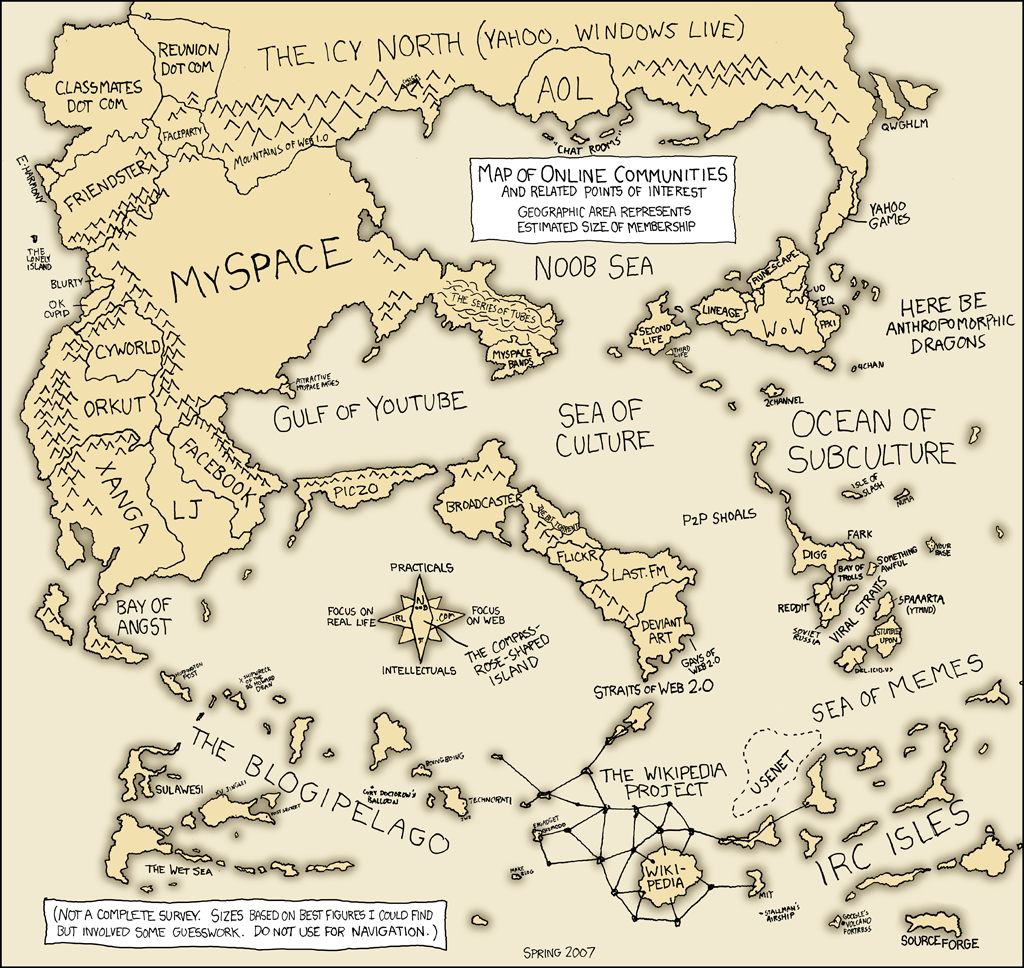
(Image courtesy of apophenia :: making connections where none previously existed)
What strikes me about these two articles is twofold: on one hand I am appreciating the human drive to socialize even as we spread ourselves afar. Social networking sites are the equivalent of the city apartment building with the too-thin walls where everyone can hear what everyone else is saying. For too long everyone believed we were becoming too distant from each other, too aloof. But the current generations of social networkers are redefining what communal life is all about. We decried that too many people don't know their neighbors next door and are aghast when something awful happens. Its always, "I didn't know them that well. They kept to themselves. They were very private." The people who use social networking sites eschew that kind of privateness and let all of the world see who they are, warts and all.
Which leads me to my second insight, the older generations who are now in positions of power are not comfortable with this kind of openness and are trying to hard to protect these people from themselves. As one commenter on the community college expulsion article stated:
As the means of communication shift more into the hands of the people we are going to have to rethink our expectations and responses to instances such as these. We have, for a long time, been teaching our children about their "rights," the right to express yourself as you see fit; the right to listen to whatever music you choose; the right to follow your dream and become what you want. What is often missed both in the home and in schools is the other side of the coin, the commensurate responsibility to use those rights sensibly with the understanding that we are all held accountable for our actions.
That's my sermon for this morning. Have a wonderful rest of the day.
Two items on The Chronicle of Higher Education's The Wired Campus new site once again had me pondering how society constantly must reshape its mores to meet the needs of the world around them. The first article is about how the University of Minnesota at Duluth has forbidden its student athletes from posting to any social networking site.
(Image courtesy of apophenia :: making connections where none previously existed)
University officials say they will lift the social networking ban next year, after they've had a chance to discuss online discretion with student -athletes But if the institution does reinstate social networking, students mayThe second item, entitled, Threat on MySpace Leads to Expulsion, talks about a student expelled from a community college for suggesting that other students in his dormitory "needed to be shot." In hindsight the student agrees his comments were "ill-considered", but he insists he meant no harm.
still feel that they’re just one embarrassing photo post away from
losing their privileges once more. Of course, that could be exactly
what the university wants.
What strikes me about these two articles is twofold: on one hand I am appreciating the human drive to socialize even as we spread ourselves afar. Social networking sites are the equivalent of the city apartment building with the too-thin walls where everyone can hear what everyone else is saying. For too long everyone believed we were becoming too distant from each other, too aloof. But the current generations of social networkers are redefining what communal life is all about. We decried that too many people don't know their neighbors next door and are aghast when something awful happens. Its always, "I didn't know them that well. They kept to themselves. They were very private." The people who use social networking sites eschew that kind of privateness and let all of the world see who they are, warts and all.
Which leads me to my second insight, the older generations who are now in positions of power are not comfortable with this kind of openness and are trying to hard to protect these people from themselves. As one commenter on the community college expulsion article stated:
People who state that they want to harm others should be taken seriously and should receive counseling. These people are trying to tell us something is wrong. Arrest and/or expulsion doesn't address the problem. There are time bombs ticking out there and we need to diffuse them BEFORE they explode.This comment is overkill on so many different levels its ridiculous. We don't have enough qualified counselors to handle the workload if we placed everyone who stated they wanted to "shoot you" or "knock your block off" into counseling. Statements like that are brought about out of passing frustration. The number of people who act on these statements are minuscule, and if they are going to act on these statements then no amount of counseling is going to help.
As the means of communication shift more into the hands of the people we are going to have to rethink our expectations and responses to instances such as these. We have, for a long time, been teaching our children about their "rights," the right to express yourself as you see fit; the right to listen to whatever music you choose; the right to follow your dream and become what you want. What is often missed both in the home and in schools is the other side of the coin, the commensurate responsibility to use those rights sensibly with the understanding that we are all held accountable for our actions.
That's my sermon for this morning. Have a wonderful rest of the day.
Powered by ScribeFire.
Subscribe to:
Posts (Atom)
